


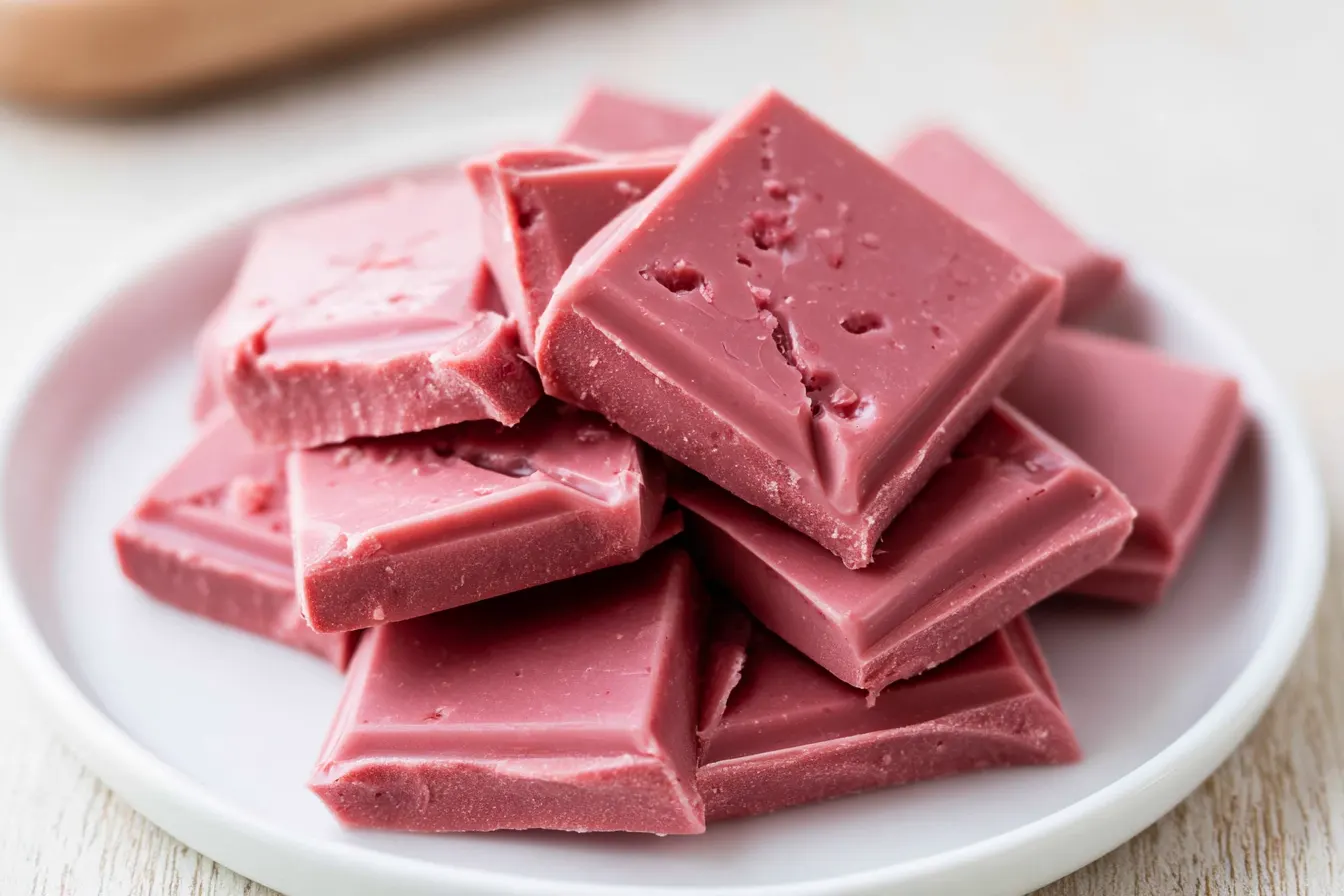
I still remember the first time I saw it. Tucked away in a specialty chocolate shop, nestled amongst familiar dark, milk, and white bars, was this impossibly vibrant, naturally pink chocolate. My immediate thought wasn’t “ooh, pretty,” but rather, “Is this some kind of marketing gimmick? What *is* ruby chocolate, really?”
Contents
- The Pink Enigma: A Deep Dive into Ruby Chocolate’s Origins
- A Taste Sensation: What Does Ruby Chocolate Taste Like?
- Decoding the Ingredients: What’s In Ruby Chocolate?
- Working with Ruby: Tips for Baking and Melting
- Pairing Perfection: What Flavors Go Well with Ruby Chocolate?
- Where to Find Your Pink Treasure: Sourcing Ruby Chocolate
- Frequently Asked Questions About Ruby Chocolate

The Pink Enigma: A Deep Dive into Ruby Chocolate’s Origins
Before we get to baking, let’s address the elephant in the room – or rather, the pink elephant. Ruby chocolate isn’t just a marketing ploy; it’s a legitimate fourth type of chocolate, joining its well-established siblings: dark, milk, and white. Its creation was the result of over a decade of research by Barry Callebaut, a Belgian-Swiss cocoa company, finally unveiled to the world in 2017.Where Does That Gorgeous Color Come From?
This is the million-dollar question, isn’t it? The stunning pink hue of ruby chocolate is entirely natural. It comes from specific cocoa beans, often referred to as “ruby cocoa beans,” which are found in various cocoa-growing regions like Ecuador, Brazil, and the Ivory Coast. These beans possess unique precursors that, through a specific processing method (which remains a closely guarded secret by Callebaut), unlock their natural pink color and distinctive fruity flavor. There are no berries, no red food coloring, and no artificial additives involved. It’s pure cocoa magic, carefully coaxed out of special beans. This natural origin is what makes ruby chocolate so intriguing and sets it apart from other colored confections.A Taste Sensation: What Does Ruby Chocolate Taste Like?
If you’re expecting a super-sweet, cloying chocolate, you’ll be pleasantly surprised. Ruby chocolate has a unique flavor profile that’s often described as intensely fruity, with a subtle tartness and a smooth, creamy finish. It’s not as sweet as milk chocolate, nor as bitter as dark chocolate. Think of it as a bright, berry-like tang, without actually tasting *of* berries. It’s a delicate balance of sweet and sour, making it incredibly versatile. Some people detect notes of red berries, while others find it more reminiscent of tropical fruits. The experience is subjective, which is part of its charm! This distinct taste makes it a fantastic ingredient for desserts where you want a hint of fruitiness without adding actual fruit.Decoding the Ingredients: What’s In Ruby Chocolate?
Like other chocolates, ruby chocolate’s primary ingredients are cocoa solids (from those special ruby beans), sugar, cocoa butter, and milk powder. The exact proportions and the specific processing of the ruby beans are what give it its signature characteristics. You won’t find any artificial colors, flavors, or fruit extracts listed in high-quality ruby chocolate. Always check the ingredient label to ensure you’re getting the real deal. The focus is on the inherent qualities of the ruby cocoa bean itself.Is it Real Chocolate? The Great Debate
Yes, absolutely! Despite some initial skepticism, ruby chocolate meets the criteria to be classified as chocolate. It contains cocoa solids and cocoa butter, just like its brethren. The unique processing method and specific bean type simply yield a different result. It’s a testament to how diverse the world of cocoa can be. Think of it less as a new *type* of food, and more as a new *expression* of chocolate.
Working with Ruby: Tips for Baking and Melting
Because ruby chocolate is a relatively new player, many home bakers are a little hesitant to incorporate it into their repertoire. But fear not! It behaves much like white chocolate in terms of melting and tempering, with a few nuances to keep in mind.The Art of Melting Ruby Chocolate
Melting ruby chocolate requires a gentle hand to preserve its beautiful color and delicate flavor. Overheating can cause it to seize or lose its vibrant pink hue. Double Boiler Method: This is my preferred method. Place finely chopped ruby chocolate in a heatproof bowl set over a saucepan of simmering water (make sure the bowl doesn’t touch the water). Stir gently until smooth and melted. Microwave Method: If using the microwave, heat in short bursts (15-30 seconds), stirring well after each interval. It’s crucial to stir even if it doesn’t look fully melted, as residual heat will continue the process. Stop heating when there are still a few small lumps, and continue stirring until completely smooth. Tip: Always use a clean, dry bowl and utensils. Even a tiny drop of water can cause chocolate to seize and become grainy.Tempering for Shine and Snap
If you’re making candies, confections, or dipped items, tempering ruby chocolate will give it that professional shine and satisfying snap. The process is similar to tempering white chocolate: 1. Melt two-thirds of your ruby chocolate to about 110-115°F (43-46°C). 2. Remove from heat and add the remaining one-third of finely chopped chocolate (seed chocolate). 3. Stir constantly until the seed chocolate is fully melted and the temperature drops to between 82-84°F (28-29°C). 4. Gently reheat, if necessary, to bring it back up to a working temperature of 86-88°F (30-31°C). Maintain this temperature while working. Tempering can seem intimidating, but practice makes perfect! A good thermometer is your best friend here.Pairing Perfection: What Flavors Go Well with Ruby Chocolate?
The unique fruity and tart notes of ruby chocolate make it incredibly versatile. It plays well with a surprising array of flavors, enhancing both sweet and savory applications. Fruits: Think berries (strawberries, raspberries, cranberries), citrus (lemon, lime, orange), and tropical fruits (lychee, passion fruit). The tartness of the fruit often complements ruby’s own subtle tang. Nuts: Pistachios, almonds, and macadamia nuts offer a lovely textural contrast and a mild, earthy balance. Spices & Herbs: A hint of ginger, cardamom, or even fresh mint can really elevate ruby chocolate. Other Chocolates: A swirl of dark chocolate provides a beautiful color contrast and a deeper flavor profile. Dairy: Cream cheese, mascarpone, and even yogurt can create delightful desserts with ruby chocolate. Consider a ruby chocolate mousse with a raspberry coulis, or ruby chocolate-dipped shortbread cookies with a sprinkle of crushed pistachios. The possibilities are truly endless once you understand its flavor personality.
Where to Find Your Pink Treasure: Sourcing Ruby Chocolate
As ruby chocolate gains popularity, it’s becoming easier to find. You can often locate it in: Specialty Baking Stores: These are usually your best bet for high-quality callets or bars. Online Retailers: Many gourmet food websites and even larger online marketplaces now carry various brands of ruby chocolate. Callebaut’s Ruby RB1 is a popular choice for bakers. Gourmet Supermarkets: Some upscale grocery stores with extensive baking aisles might stock it. Chocolatiers: Local artisan chocolatiers might use it in their creations, giving you a chance to taste it before buying a larger quantity. Look for it in callet (small disc) form, which melts beautifully, or in solid bars that you can chop yourself.Frequently Asked Questions About Ruby Chocolate
Curiosity about this pink marvel is always high! Here are some common questions I hear.Is ruby chocolate healthy?
While it’s derived from cocoa beans, ruby chocolate is still a confection and contains sugar and fat. It’s best enjoyed in moderation as part of a balanced diet, just like any other chocolate. It doesn’t offer any specific health benefits that significantly outweigh other types of chocolate.Can I substitute ruby chocolate for white chocolate in recipes?
In many recipes, yes, you can. They share similar melting characteristics and sweetness levels. However, be mindful that ruby chocolate has a distinct fruity and tart flavor that will significantly alter the final taste of your dish. It’s not a neutral substitute, so ensure its flavor profile will complement your recipe.Does ruby chocolate contain any artificial colors or flavors?
No, genuine ruby chocolate gets its color and flavor entirely from the unique processing of specific ruby cocoa beans. There are no added artificial colors, flavors, or fruit extracts. Always check the ingredient list to confirm.How should I store ruby chocolate?
Store ruby chocolate in a cool, dry place, away from direct sunlight and strong odors. An airtight container is ideal to prevent it from absorbing other smells. Like other chocolates, it’s best kept at around 60-68°F (15-20°C). Avoid refrigerating it unless absolutely necessary, as temperature fluctuations can cause blooming (a white, powdery film on the surface) or condensation.Is ruby chocolate vegan or dairy-free?
Most commercially available ruby chocolate contains milk powder, so it is generally not vegan or dairy-free. Always check the ingredient label for specific dietary needs. There might be some specialty brands developing dairy-free versions, but they are not the norm.
Ruby Chocolate Bark with Pistachios & Dried Cherries
A vibrant and elegant ruby chocolate bark, studded with crunchy pistachios and tart dried cherries.
📝 Ingredients
👩🍳 Instructions
- 1Line a baking sheet with parchment paper or a silicone mat. This will prevent sticking and make for easy cleanup.
- 2Gently melt the ruby chocolate. You can use a double boiler or a microwave. If using a double boiler, place chopped chocolate in a heatproof bowl over a saucepan of simmering water, ensuring the bowl doesn't touch the water. Stir occasionally until smooth. If using a microwave, heat in 30-second intervals, stirring well after each, until mostly melted, then stir until completely smooth. Be careful not to overheat to maintain its vibrant color and delicate flavor.
- 3Pour the melted ruby chocolate onto the prepared baking sheet. Use an offset spatula or the back of a spoon to spread it into a thin, even layer, about 1/8 to 1/4 inch thick. Aim for a rectangular or square shape, roughly 8x10 inches.
- 4While the chocolate is still wet, sprinkle the chopped pistachios and dried cherries evenly over the surface. Gently press them down lightly so they adhere to the chocolate.
- 5Allow the chocolate bark to set completely. You can leave it at room temperature for 1-2 hours, or place it in the refrigerator for 20-30 minutes for faster setting. Once firm, break the bark into irregular pieces with your hands or carefully cut with a sharp knife.
- 6Serve immediately or store for later enjoyment.
💡 Notes
For an extra touch, you can add a pinch of flaky sea salt before it sets. This bark makes a beautiful homemade gift! Store in an airtight container at cool room temperature for up to 2 weeks.
🥗 Nutrition (per serving)
Calories 280 kcal
Protein 4g
Total Fat 18g
Saturated Fat 10g
Carbs 28g
Fiber 2g
Sugar 25g
Sodium 25mg
Cholesterol 10mg
Rate This Recipe
☆ ☆ ☆ ☆ ☆